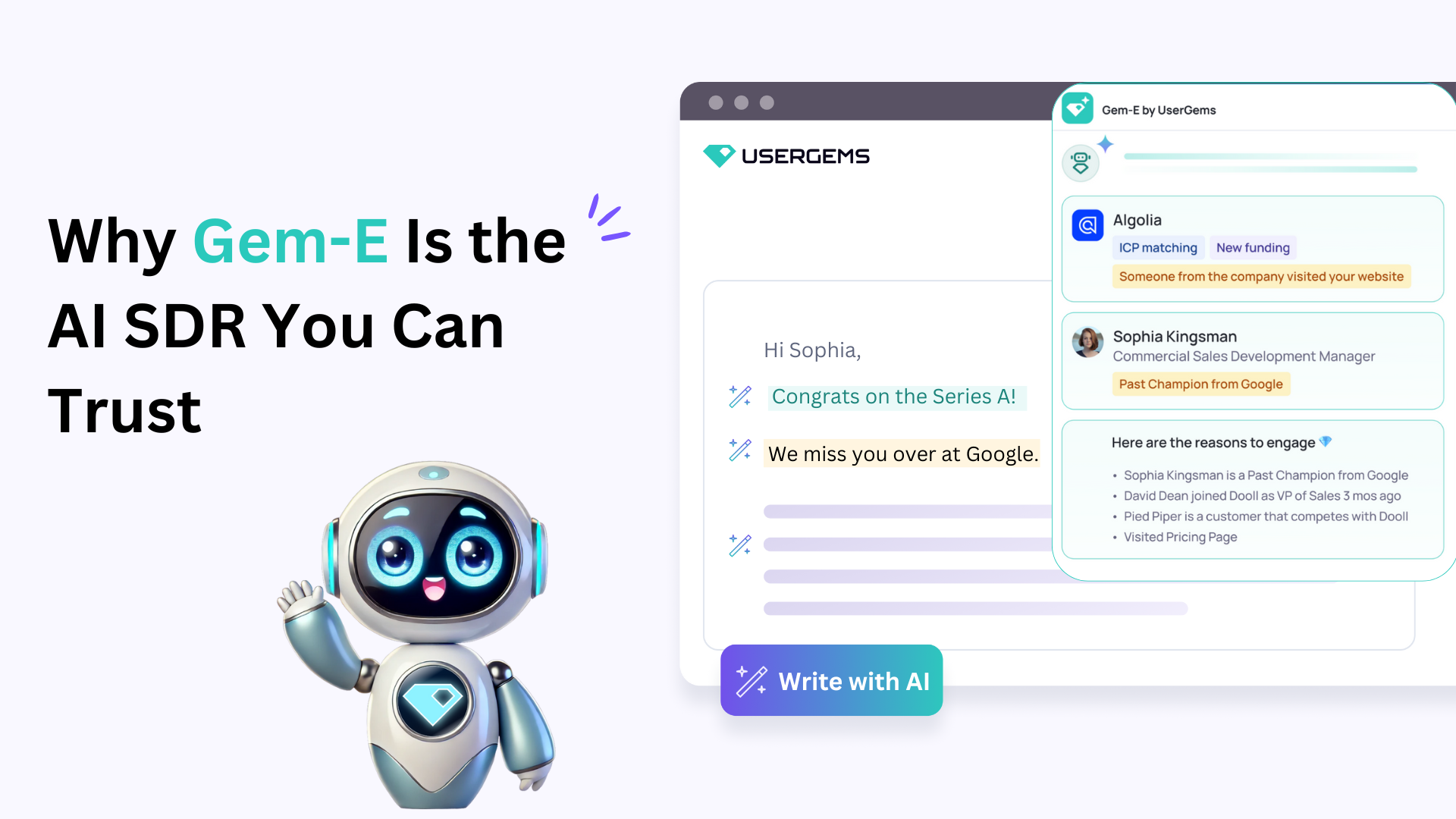
Every week brings another “AI SDR” promising to write your emails and book meetings while you sleep.
Most of them automate more noise.
What actually drives pipeline: smarter inputs (signals + CRM context) and intelligent orchestration.
Gem-E by UserGems is an AI outbound agent trained to think and act like your best rep. It prioritizes the right people, writes relevant multi-touch sequences, and activates them directly where your team already works.
And it all starts with the one thing every great AI depends on: accurate, up-to-date data.
1. Better Data
In AI, your output is only as good as your input.
As Derek Wang, Director of Sales at UserGems, says:
“A Shakespeare-level email written for the wrong person? Still not getting a reply.”
That’s why Gem-E starts with data accuracy — the foundation for everything that follows.
Contact data that’s always right
UserGems consistently wins head-to-head data tests.
Our proprietary contact data comes from in-house generation and verification. Contact data is generated in-house and verified, with signals such as job changes, promotions, and more, consistently delivering a less than five-percent bounce rate across millions of verified contacts.
When Gem-E writes, it knows exactly who they are, why now, and how to reach them with verified contact information.
2. Intelligent Orchestration
Most AI tools can personalize. Few can reason across data points to write messages grounded in real buyer context.
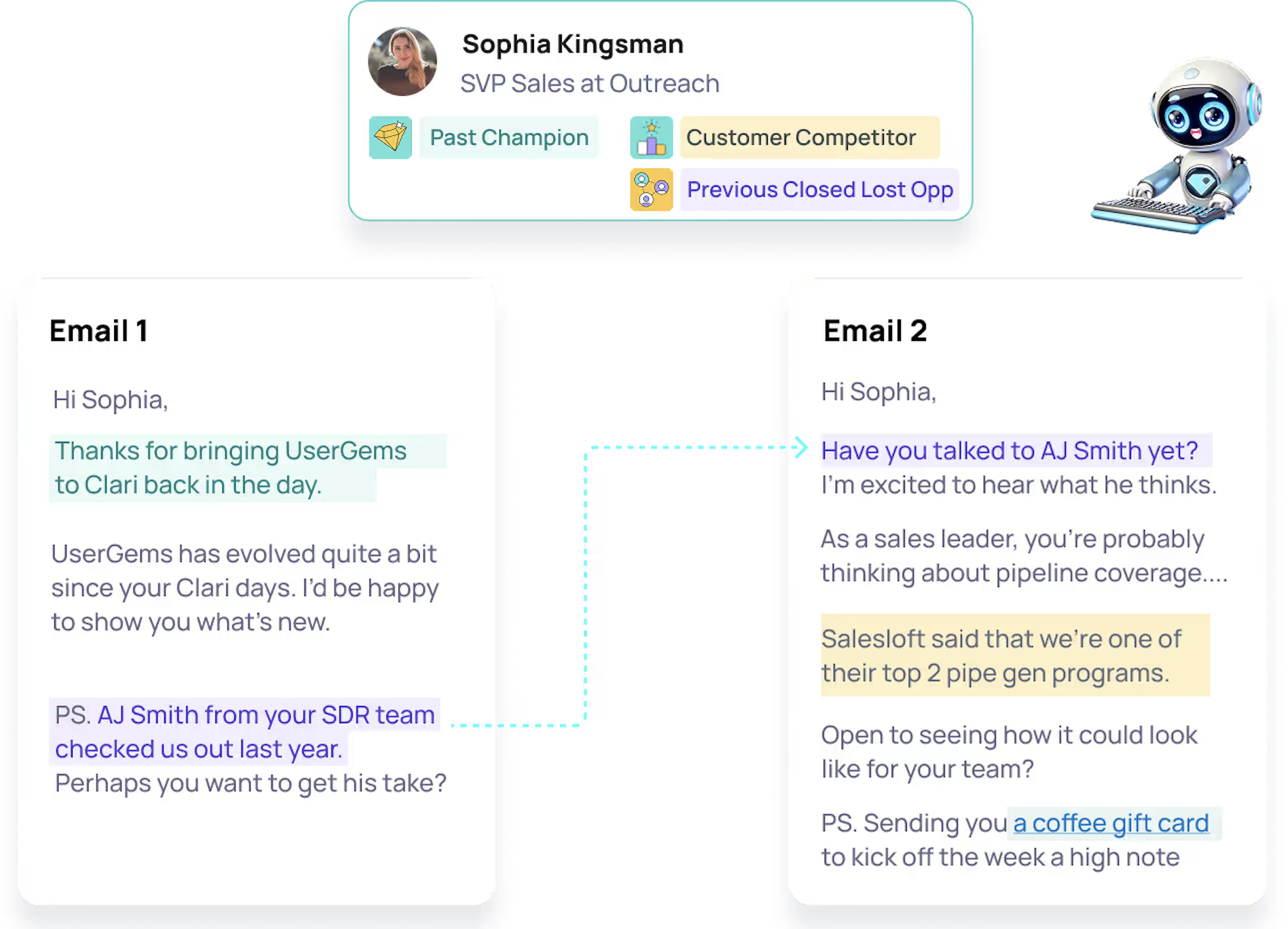
Gem-E does both. It pulls together everything it knows about a specific prospect, for example a recent promotion, a past evaluation at the company, and a competitor relationship, into one cohesive narrative.
Other platforms depend on RevOps, agencies, or GTM engineers to wire this logic manually. UserGems does this natively.
Context That Knows Your Business
Gem-E understands relationship context, not just surface-level data. It understands relationship context: who’s worked with you before, what happened in past evaluations, and how prospects engaged previously.
Using insights from call recordings, emails, and CRM activity, Gem-E recognizes the difference between a past closed-won opp contact, a hands-on user, and an evaluator who didn’t convert, and it adapts its messaging to match.
3. From Draft to Delivery
Gem-E writes full, connected sequences that evolve with every new signal and are ready to send as-is.
Gem-E does it all. It writes full, connected sequences that evolve with every new signal and are ready to send as-is.
Each touch feels natural because Gem-E understands the full story. The first message might congratulate a buyer on a new role and mention a teammate (i.e., John) who evaluated UserGems before. The follow-up could naturally ask, “Did you get a chance to chat with John about his experience?”
Behind the scenes, Gem-E’s advanced AI agent automatically pulls in relevant case studies, marketing resources, calendar links, or gifting options: everything reps would normally add by hand.
You get Launch-ready messaging that sounds like your best reps and syncs directly to your SEP — with direct SEP sync and launch-ready messaging.
4. Customizable and Controllable
Other “AI SDR” tools are black boxes. Adjusting tone, adding value props, or including content like case studies requires a support ticket.
With Gem-E:
Upload your company’s content (sample emails, case studies, gifting links)
Chat directly with Gem-E to shape messaging across all campaigns
.gif)
You don’t need a prompt engineer to keep messaging on-brand or include what your reps usually add by hand. Gem-E gives you control and transparency.
5. How Gem-E by UserGems Stacks Up
How Gem-E compares in practice:
Clay: Excellent for technical teams, but requires a RevOps resource or a Clay agency to stitch data and prompts together. You can still bring Clay’s custom signals into UserGems and combine them with our best-in-class data and orchestration.
Common Room: Great for product-led teams focused on community activity (Slack, GitHub) or product usage signals (feature adoption, usage spikes). They offer “out-of-the-box” AI prompts, but creating dynamic messaging still requires heavy prompt knowledge.
6sense: Ideal if your strategy centers on paid ads and account-level intent. Their AI SDR focuses primarily on inbound reply handling.
ZoomInfo: A good fit if you want reps working individually rather than following guided playbooks or workflows.
Gem-E unites data, intelligence, and execution. Others make you choose.

6. Team of Gem-Es — and What’s Next
Outbound Gem-E is just the beginning.
UserGems is building a team of AI agents, each focused on a specific GTM role:
Gem-E: outbound prospecting
Coming soon: advertising and ABM
Think of it like a team of specialists. Each Gem-E has its own “superpower,” but they all share the same UserGems brain: your trusted command center for orchestrating signals and CRM data.
Together, they’ll redefine how GTM teams run AI: intelligent agents you can trust, understand, and control.

.png)
.png)
.png)
